Why hockey totals sit at 5.5 and 6.5 — and what moves one
Open tonight's NHL card and look at the totals. Seven games: five sit at 6.5, two at 5.5, nothing anywhere else. That is not a quirk of one night. Hockey totals live in a narrow band because hockey scoring does — a typical game lands near 6 goals. This is how that number is built, and what moves it.
Where 6.5 comes from
The model starts with two numbers: how many goals the home side is expected to score, and how many the away side is expected to score. Add them, and you have the model total. Tonight the two sides run from 2.5 to 3.5 goals each, so the sums land between 5.5 and 6.5. Toronto against Colorado is the highest of the night at 6.5, Toronto at 2.5 goals and Colorado at 4; Montreal against Minnesota is the lowest at 6.0, 3 goals each. Five of tonight's seven games carry a model total of 6.0, two carry 6.5, and the market line sits at the nearest half point to the middle of the scoring distribution: 6.5 on five games, 5.5 on the other two.
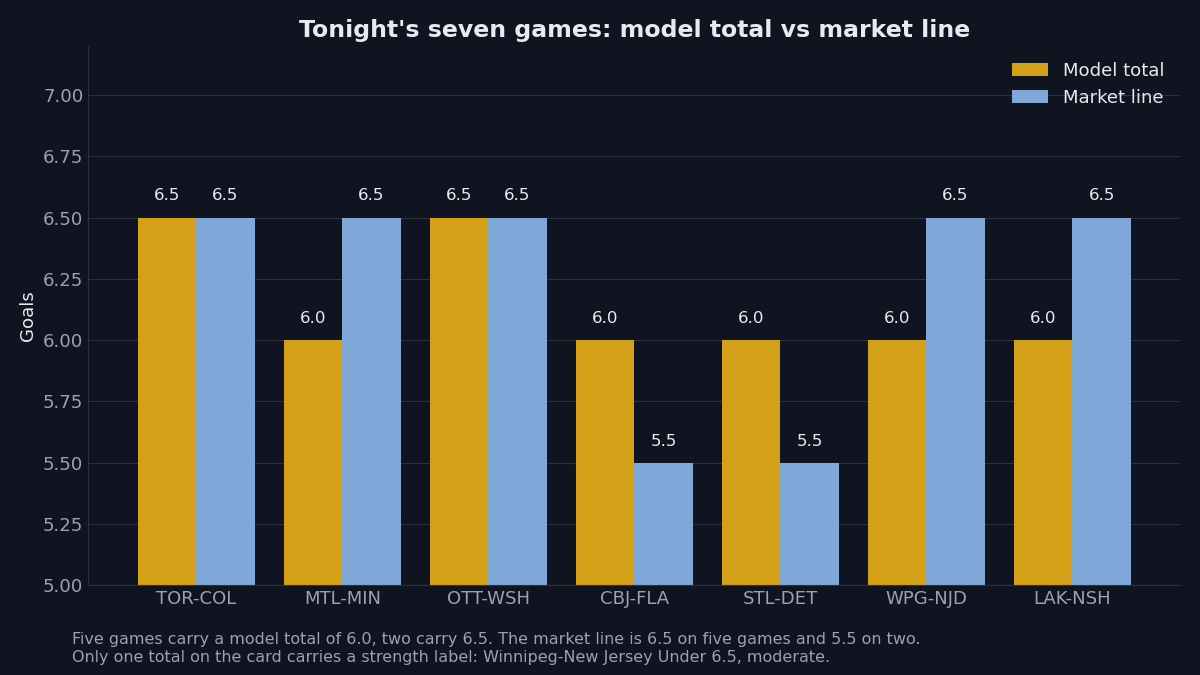
The line is not the model number restated. It is the market's own number, and tonight the two agree on the shape even where they differ on the side. Six of the seven games show a total lean on the Under side. In three the reason is plain: the model total is 6.0 and the line is 6.5. In the other three the lean is thin. Columbus against Florida is a dead heat, the model at 46% against the market at 45.5%. Only Ottawa against Washington points Over, at 50% against 48.5%. And only one total on the whole card carries a strength label: Winnipeg against New Jersey, Under 6.5, moderate, the model at 57.5% against the market at 51%. Montreal against Minnesota has a 5-point gap and no label — a gap alone does not earn one.
The whole distribution, not just the average
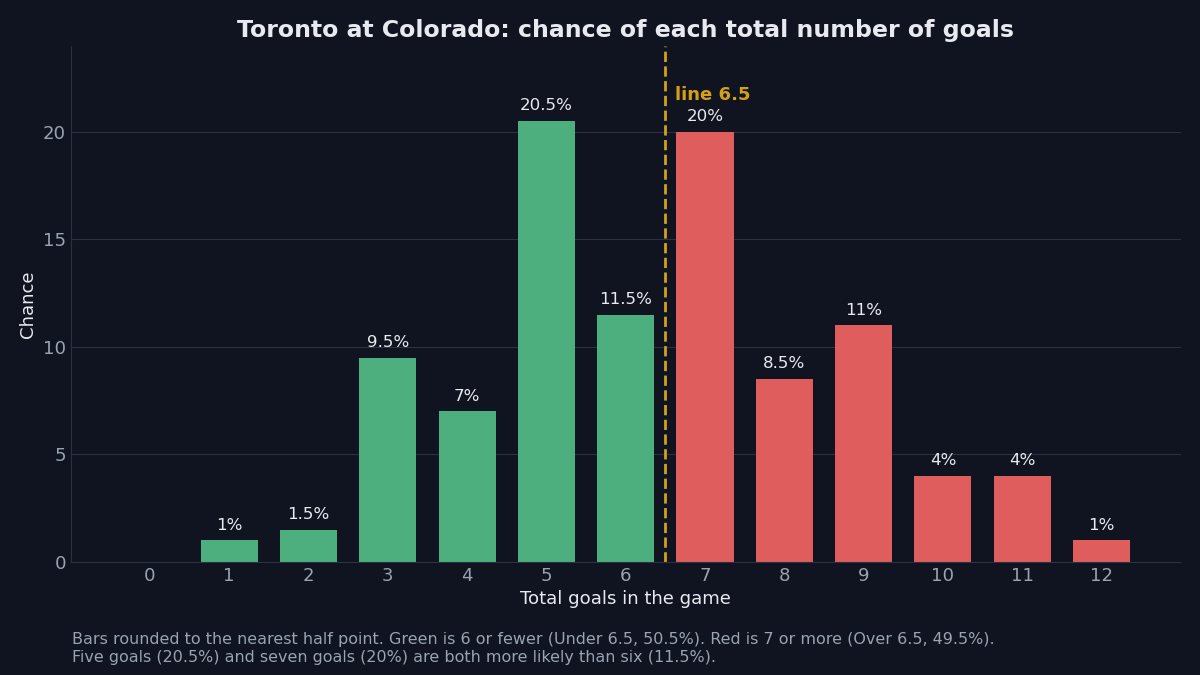
A single number hides the shape. The model holds a probability for every total from 0 to 12 in Toronto against Colorado, not just an expected 6.5. Five goals is the single most likely outcome at 20.5%, seven goals is next at 20%, and six goals sits at 11.5% — less likely than either neighbor. That dip is overtime. A 3-3 game does not end 3-3: it goes to overtime, and the extra goal usually lands before the shootout, so probability moves from 6 to 7. About one game in five goes past regulation; the tie chance runs from 19.5% to 21.5%. Add the bars at 6 and below and you get the published Under number: 50.5%, against a market at 48.5%. A coin flip with a price attached — which is why it carries no label.
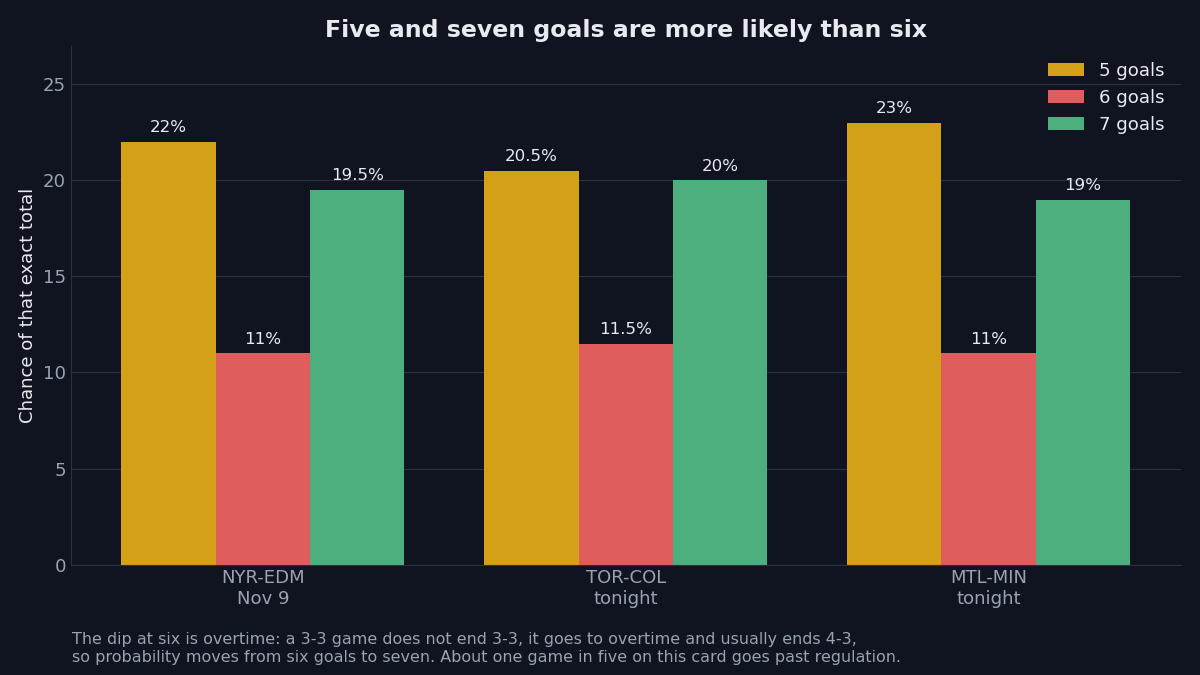
The same dip shows up in every game on the card. In the Rangers at Edmonton last night the split was 22%, 11%, and 19.5% for five, six, and seven goals. In Montreal against Minnesota tonight it is 23%, 11%, and 19%. The cause is the same: the rules push tied games past 6, so 6 is the least likely number in the middle, not the most likely.
Why the half goal matters
Goals come in whole numbers, so a total of 6.0 would push whenever exactly six goals are scored. In the Toronto against Colorado distribution that happens 11.5% of the time — about one game in nine would end in a refund. The half goal removes the push: every total settles one way or the other, and the price does the balancing instead. That is why the line is 6.5 and not 6. When the model total sits at 6.0 and the line sits at 6.5, the half goal is doing real work: the Under side needs six or fewer, the Over side needs seven or more, and the model's own numbers say seven is more likely than six. The price then tells you which side the market leans toward: Under 6.5 is -102 in Toronto against Colorado, -125 in Montreal against Minnesota.
What moves a total
A total moves when the expected goals move, and the biggest single mover is the name in net. Columbus against Dallas on November 5 showed the shape: 5.5 with Greaves projected in net, 6.0 with Talbot — a half-goal swing from one name. Tonight the goalie questions are smaller: Toronto against Colorado runs from 6.5 with Bobrovsky to 6.5 with Stolarz, the raw numbers about a fifth of a goal apart. The line only moves when a change pushes the number across a half-point boundary. The model total for Toronto against Colorado sat at 6.5 all week while the goalie question stayed open. Philadelphia at Vancouver sat between 5.5 and 6.0 all week while the line sat at 6.5, and that gap is where the strong Under came from: the model at 63.5% against the market at 54.5%. The game finished Philadelphia 3, Vancouver 1, four goals, for +0.77u.
What the record says
Totals are the quietest market on the card this season: 74-73, -3.72u through last night. Last night both graded totals won: Under 6.5 slight in the Rangers at Edmonton, Edmonton 3, Rangers 1, for +0.93u, and Under 6.5 strong in Philadelphia at Vancouver, Philadelphia 3, Vancouver 1, for +0.77u. Tonight only one total carries a label: Winnipeg against New Jersey Under 6.5, moderate. The rest are numbers without a label — the model and the market close enough that the pick stays off the card. That is the point of the half goal: it turns a small disagreement into a clear line.
You must be 21 or older to wager. If you or someone you know has a gambling problem, call 1-800-GAMBLER.