Which players play better with which balls?
The ball is the one piece of equipment nobody controls. A fresh ball rewards the server. A worn ball rewards the returner. A heavy ball favors the spin player, a light ball the flat hitter.
Four Slams, four balls
There is no single tour ball: the four Grand Slams use four different balls, each built for its surface. The Australian Open uses a Dunlop ball built for extreme heat, since heat makes felt fluff up and play quicker. Roland Garros uses a heavier, grippier Wilson ball: on clay the extra weight helps it cut through the surface, slow the game, and lift the bounce. Wilson has been the official ball there since 2020. Wimbledon uses a lighter Slazenger ball, which keeps the bounce low on grass; Slazenger has supplied Wimbledon since 1902. The US Open uses a Wilson ball built for durability on abrasive hard courts, split by draw: the women play with a regular-duty Wilson ball, the men with a fluffier extra-duty version. Official balls weigh 56 to 59.5 grams.
Fresh balls favor the server. Worn balls favor the returner.
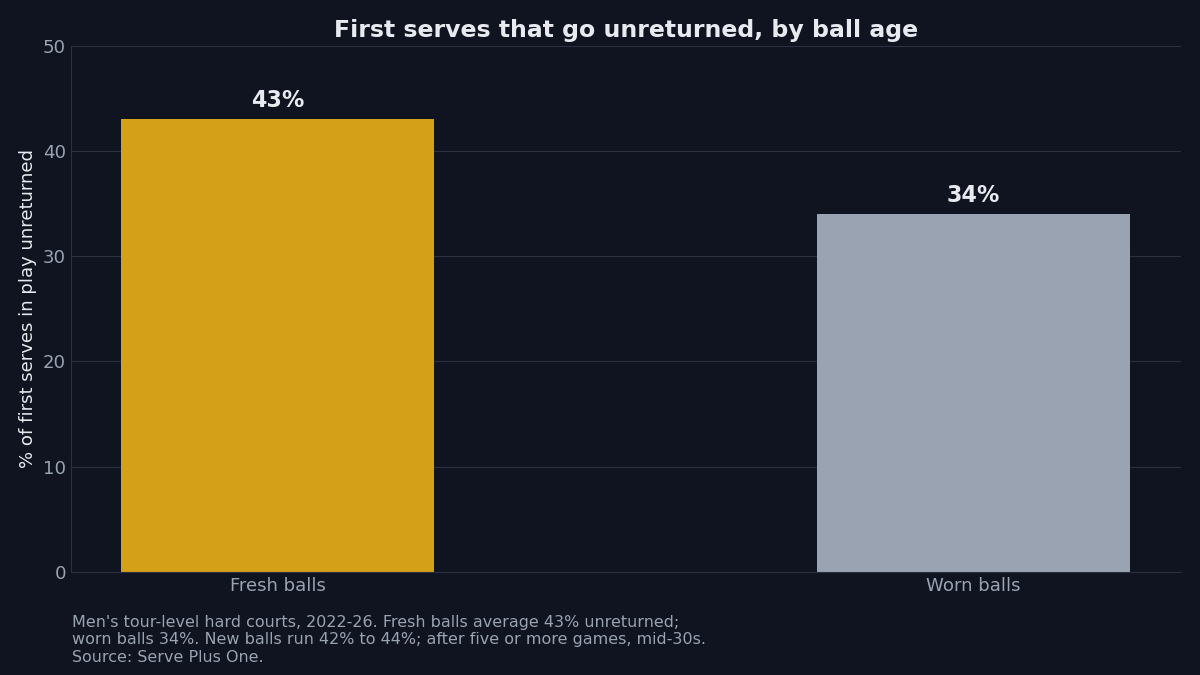
A ball changes as a match goes on: it loses pressure, the felt fluffs up, and it gets heavier and slower. Serve Plus One, a tennis data site, measured the effect on men's tour-level hard courts in 2022-26. With fresh balls, 43% of first serves in play go unreturned, falling to 34% with worn balls, down from 42% to 44% with new balls to the mid-30s after five or more games.
A big server lives on the fresh ball: the first few games of a new set are the best window to hold serve cheaply, and serves near the lines in that window are the hardest to return. Serve Plus One's Australian Open heat maps show serves near the sideline or the T going unreturned 60% to 90% of the time, against 15% to 25% for serves landing mid-box. As the balls wear, the balance shifts to the returner and the rally player: a fluffed ball sits up, gives the returner more time, and rewards long exchanges. The heavy topspin player gets more from a worn, grippy ball than the flat hitter does.
The tours know this. The ATP trialled a faster rotation at the Lexington Challenger in 2026, a first change after five games and then every seven, and Stockholm trialled changes every seven games on indoor hard courts. More frequent changes keep the serve stronger for longer: in 2025-26, 84% of the top 50 held at least 80% of their service games on hard courts, led by Sinner at about 92.5%.
The serve-plus-one split
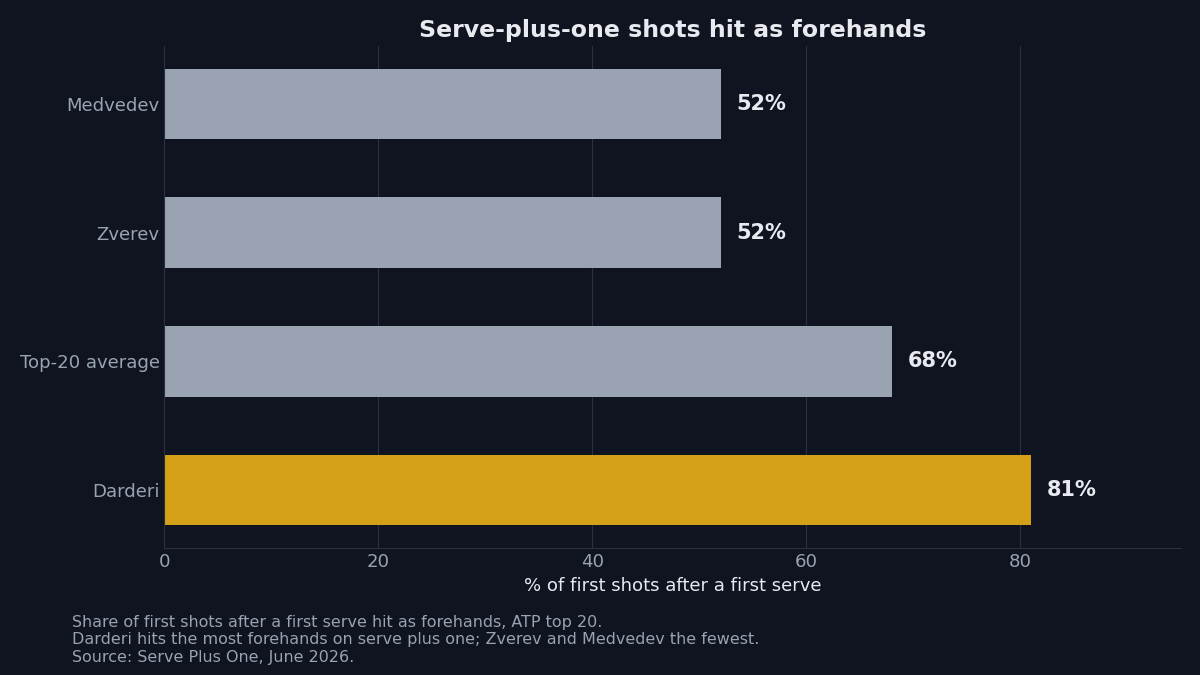
The first shot after the serve is where ball differences show up in a player's numbers. Serve Plus One's chart of the ATP top 20 shows that on average 68% of serve-plus-one shots are forehands: Luciano Darderi hits the most, at 81%, and Alexander Zverev and Daniil Medvedev hit the fewest, at 52% each.
The gap matters because the forehand is the better shot on serve plus one. Felix Auger-Aliassime has the largest edge in the top 20: he wins 62% of points when his serve-plus-one shot is a forehand, against 47% when it is a backhand, a 15-point gap, while Medvedev has the smallest edge, at 2 points. The forehand-heavy server wants a fresh, fast ball that lets the serve-plus-one forehand end points. The backhand-heavy player, Medvedev most of all, is less dependent on the ball doing the work.
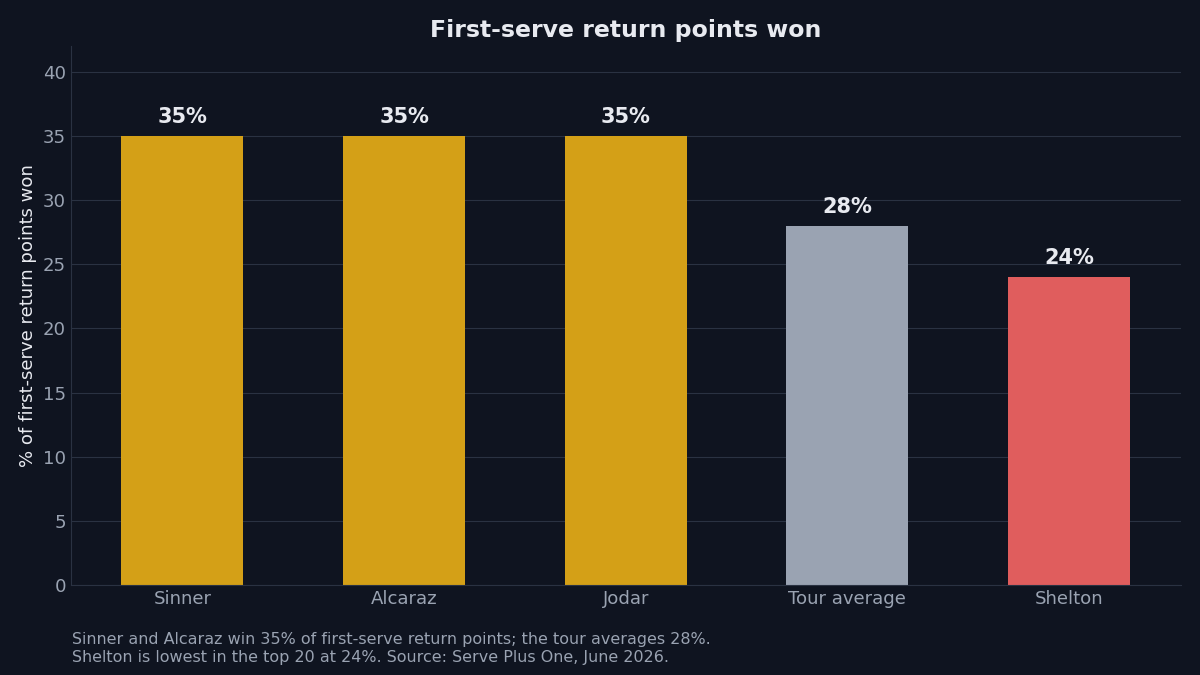
Sinner and Carlos Alcaraz win 35% of first-serve return points while getting 68% to 69% of returns back in play, against tour averages of 65% in play and 28% won. Against Sinner or Alcaraz, top-20 servers win only 65% of their first-serve points, against 72.5% against each other, and their serve-plus-one forehand wins 6.5 points less often, their backhand 8.5 points less often.
The players who argue about it
No topic divides the locker room like the ball. Novak Djokovic said in 2023 that there is a connection between frequent wrist, elbow, and shoulder injuries and ball changes, and proposed a single ball for all ATP tournaments. Taylor Fritz blamed the 2025 Australian Open balls for an oblique injury, calling them the deadest balls ever. Alexander Zverev said the balls are 30% to 60% slower than before COVID. Alcaraz said the ball becomes super big as it wears. Medvedev complained about the Tecnifibre balls in Rotterdam, his own sponsor's ball.
The injury numbers give the argument weight: upper-body injuries were up 42% in the first quarter of 2026, with arm injuries up 112%, per the Professional Tennis Players Association. The PTPA itself blamed the long season rather than the ball, and a November 2026 review found the evidence linking ball properties to elbow injury remains limited. But the players' experience is consistent: as balls lose pressure and fluff up, they play heavier and slower, so players swing harder. The ATP and WTA launched a review of tour balls in January 2024, and the ATP took over ball supplier selection starting in 2025.
What the pros look for in the can
Watch a server before a first serve: three balls, a quick feel of each, one sent back. The server wants the least fluffy ball for the first serve: less fluff means less drag and more pace. For the second serve, many prefer a slightly softer, fluffier ball, because the felt grips the strings and shapes a kick serve.
The ball is never neutral. A fresh ball favors the server and the forehand. A worn ball favors the returner and the rally. A heavy ball favors the spin player; a light ball favors the flat hitter. The players who play best with a given ball are the ones whose game already points the way the ball pushes.
21+. If gambling stops being fun, call or text 1-800-GAMBLER.