How balls and surfaces affect each other
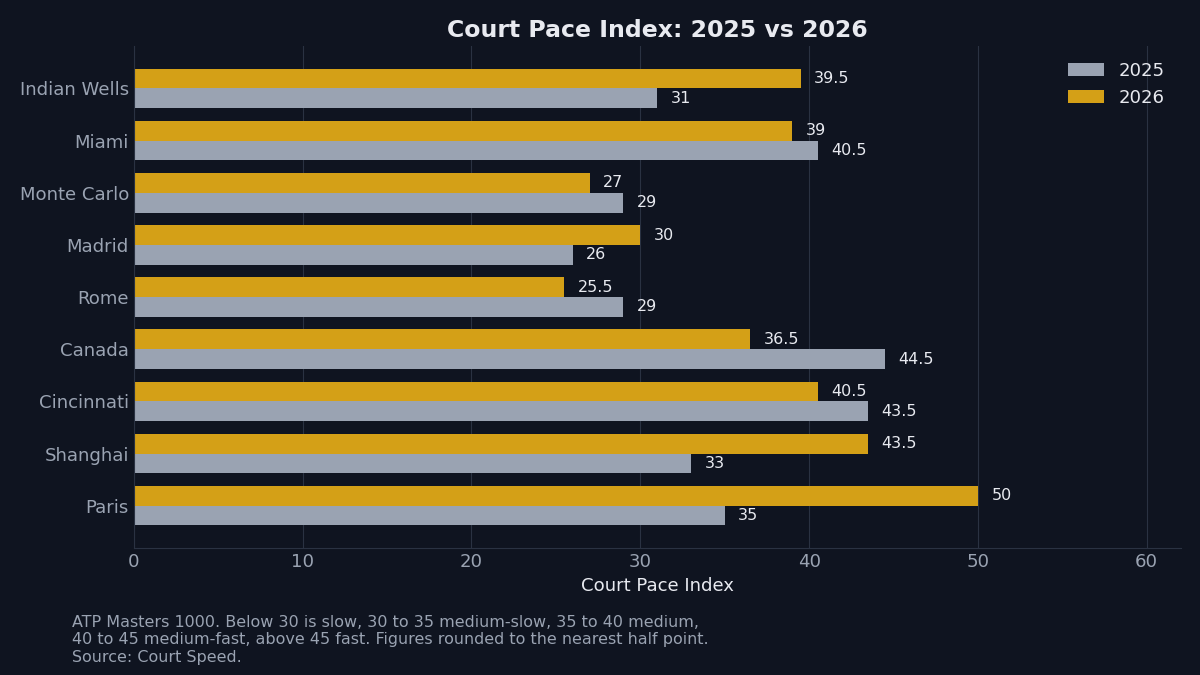
A tennis court has no speed on its own, and neither does a tennis ball. What you watch is the combination. The Court Pace Index, or CPI, tracks how fast a court plays, built from serve and rally data. Below 30 is slow, 30 to 35 medium-slow, 35 to 40 medium, 40 to 45 medium-fast, above 45 fast. But a CPI reading is a reading of a court with a particular ball on it, in particular weather, and changing the ball changes the reading. Court Pace Index figures below are rounded to the nearest half point.
The 2026 shifts
Court Speed, a site that tracks CPI across the tour, shows how much the combination can move in a single year. Indian Wells went from 31 in 2025 to 39.5 in 2026. Shanghai went from 33 to 43.5. Paris went from 35 to 50, the fastest reading on the list. On the other side, Canada fell from 44.5 to 36.5, Rome from 29 to 25.5, and Miami from 40.5 to 39.
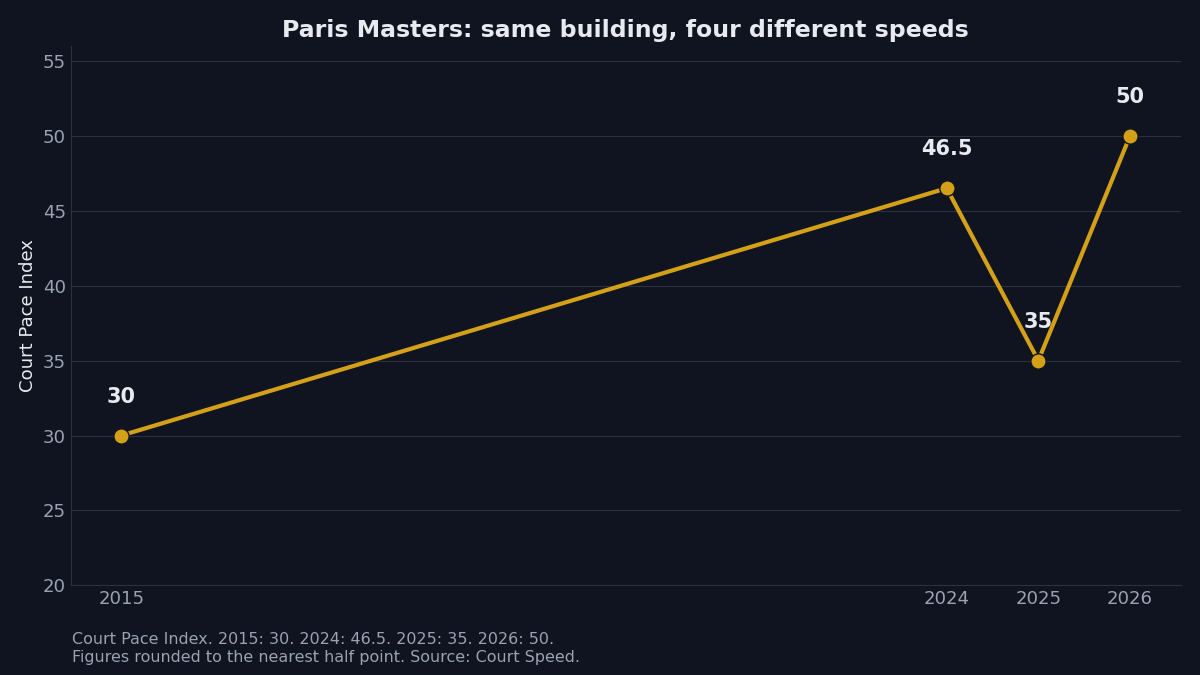
Paris is the wildest line in the data. The Paris Masters measured 30 in 2015, clay-court speed on an indoor hard court. By 2024 it was 46.5. In 2025 it dropped to 35. In 2026 it hit 50. Same building, same surface family, four very different speeds: the court did not change that much, but the ball, the resurfacing, and the conditions did.
Clay shows the same range. Roland Garros measured 21 in 2017, the slowest reading in the database. Monte Carlo was 29 in 2025 and 27 in 2026. Madrid was 26 in 2025 and 30 in 2026. The clay swing is slow, but not one speed: Madrid sits higher above sea level than Monte Carlo, and thin air lets the ball fly.
Why fluff and friction decide the speed
Two things decide how a ball and a surface interact: drag in the air and grip on the ground.
Drag comes from the felt. A new ball has tight felt and flies cleanly. As the felt fluffs up, the ball catches more air, slows down, and gets heavier as it picks up dirt and moisture. A fluffy ball on a rough hard court is slow twice over: it drags in the air and it grips on the bounce. That is the combination David Witt, the former coach of Venus Williams, complained about in 2026: a ball that fluffs up on a court that plays like sandpaper, where you cannot hit a winner because the ball will not come through.
Grip comes from the surface. Clay grabs the ball, kills pace, and throws it up high, which is why the French Open ball is heavy and grippy, built to cut through the clay rather than float on it. Grass does the opposite: the ball skids low and fast, which is why Wimbledon uses a lighter ball that keeps the bounce down. Hard courts sit in the middle, and the US Open ball is built for durability, to hold its pressure and felt over long matches on an abrasive surface.
The wrong pairing is what players notice most: a light ball on a hot clay court fluffs up and plays too fast for the surface, and a heavy ball on a slick indoor court stays slow when the court wants to be fast. The tours try to match ball to surface, regular-duty felt for clay and grass and extra-duty for hard courts, but the match is never exact, because every tournament signs its own ball deal.
Wimbledon has not slowed down. The air has changed.
Wimbledon is the best test of the ball-surface question, because the court itself has barely changed. The grass has been 8mm long since 1995. The seed has been ryegrass since 2001. The ball pressure has been the same since 1995. Yet people keep saying Wimbledon is getting slower.
Average rally length at Wimbledon has moved between about 3.5 and 4 shots per point since 2004, with no long-term rise. What it tracks instead is air density: the correlation is near 0.5 overall, and near three quarters for year-to-year changes. Warm, humid air is thinner, so the ball flies faster and rallies get shorter. Cold, heavy air does the opposite. The court is the same. The air is the variable, and the ball is the thing the air acts on.
That is the cleanest proof: when the surface is held constant, the ball and the weather still move the speed of the game.
The ball change is a lever on the whole match
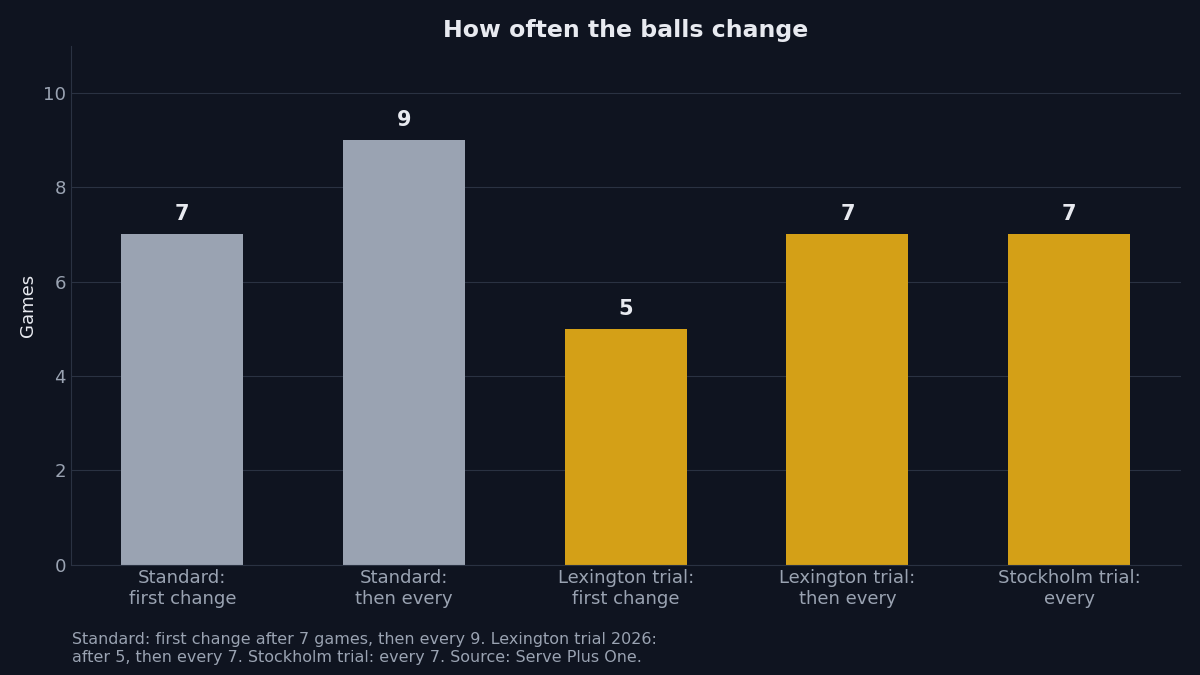
The last lever is how often the balls are changed. The standard is a first change after seven games, then every nine. As the balls wear, the serve gets weaker: Serve Plus One measured 43% of first serves in play going unreturned with fresh balls on men's hard courts, falling to 34% with worn ones.
Change the balls more often and the serve stays stronger for longer. The ATP trialled that at the Lexington Challenger in 2026, a first change after five games and then every seven. Stockholm trialled changes every seven games on indoor hard courts. The effect is small in any single match, but across a season it shows up in ace rates and hold rates, and it nudges a game that is already serve-dominant a little further in that direction.
So the ball and the surface are not two separate conditions. They are one condition, made of felt, friction, air, and altitude. A court speed number only means something with a ball attached to it. Read them together.
21+. If gambling stops being fun, call or text 1-800-GAMBLER.